Inherited Bone Marrow Failure Syndromes
Inherited Bone Marrow Failure Syndromes (IBMFS)
IBMFS: Inherited Bone Marrow Failure Syndromes (IBMFS) are a very rare set of genetic disorders in which the bone marrow—which is the body’s blood cell manufacturing facility—fails to make enough blood cells. The conditions are passed on through families and generally manifest at a young age, but certain cases may develop later. IBMFS may affect the production of white blood cells or platelets. They may also be related to specific physical characteristics or specific abnormalities in lab tests.
What Are IBMFS?
Contrary to the acquired marrow loss due to infections, toxins, or autoimmune diseases, IBMFS are genetic in their genesis. Certain genes are affected by mutations that hinder the bone marrow’s stem cells from growing into healthy blood cells. In time, this may result in aplastic anemia (low levels of production for all blood types) and organ damage and an increased risk of developing cancer, specifically acute myeloid leukemia (AML) and various cancers that are solid.
Common Features
While the symptoms may vary based on the disorder, all bone marrow disorders share these characteristics:
-
Low blood counts that persist (pancytopenia or affects one cell line)
-
Greater susceptibility to infections Anemia, bleeding, or infections
-
Physical abnormalities (such as changes in skin coloration or irregularities in skeletal structure)
-
Children who are experiencing delays in growth may have a problem.
-
A family background of similar disorders and early-onset blood cancers
Major Types of Inherited Bone Marrow Failure Syndromes
1. Fanconi Anemia (FA)
A DNA repair disorder characterized by bone marrow deficiency, growth retardation, thumb/radial anomalies, and changes in pigmentation. Patients are at risk of developing leukemia as well as solid tumors, particularly neck and head cancers.
2. Diamond-Blackfan Anemia (DBA)
A condition of production of red blood cells that generally manifests in early childhood. Children can present as having severe anemia or facial anomalies and kidney or thumb malformations. DBA is usually treated through transfusions or steroids and can progress to bone anemia or cancer.
3. Dyskeratosis Congenita (DC)
This telomere-related biology disorder has weak DNA ends, which can lead to premature cell death. It could manifest with nail dystrophy, skin pigmentation change, and oral leukoplakia, as well as bone marrow dysfunction. There is a higher risk of lung cancer and pulmonary fibrosis.
4. Shwachman-Diamond Syndrome (SDS)
A condition that affects primarily the pancreas and bone marrow. Patients can suffer from neutropenia (low neutrophils) and recurrent infections. pancreatic insufficiency, as well as the presence of skeletal anomalies. There is a high chance of developing into myelodysplastic syndrome (MDS) or leukemia.
5. Severe Congenital Neutropenia (SCN)
It is characterized by a dangerously low level of neutrophils at birth, and it can trigger chronic life-threatening infections. SCN is controlled through granulocyte colony stimulating factor (G-CSF); however, it is a risk for the long term, including MDS and leukemia.
6. Thrombocytopenia Absent Radii (TAR) Syndrome
The condition is characterized by lower platelet counts since birth and the bilateral absence of radius bones within the forearms. The bleeding problems typically improve over time; however, careful monitoring is still necessary.
7. Amegakaryocytic Thrombocytopenia (Amega)
A rare disorder that causes the isolated failure of platelet-producing cells (megakaryocytes), which can lead to an ongoing low platelet count and the risk of bleeding. It can progress to bone marrow dysfunction.
8. Pearson Syndrome
The cause is mitochondrial DNA mutations. This condition causes sideroblastic anemia as well as pancreatic dysfunction. It could later develop into Kearns-Sayre syndrome, which is a neuromuscular disorder.
Diagnosis of IBMFS
Early as well as accurate diagnoses are crucial for proper management and surveillance. The most important diagnostic tools are:
-
Complete Blood Count (CBC) to assess the levels of blood cells
-
Bone Marrow Biopsy to assess the marrow’s cellularity and function
-
Genetic Test to determine the root cause of the mutation
-
Telomere Length Testing (especially in DC)
-
Chromosome Breakage Research (for Fanconi anemia)
-
Family Screening where a genetic mutation is present
Management & Treatment Options
The treatment depends on the specific condition and the extent. Treatment typically comprises:
-
Helpful Care Blood transfusions and Growth factors (e.g., G-CSF, erythropoietin)
-
Infection Control: Antibiotics, antifungal prophylaxis
-
Hematopoietic Stem Cell Transplant (HSCT): The sole curative treatment for the majority of IBMFS, especially those who are progressing towards leukemia or bone marrow failure.
-
Gene Therapy: A rapidly developing area of study for genetic disorders that are specific to a particular gene
-
cancer surveillance Continuous monitoring for the first signs of malignancy
Living with IBMFS
Being a victim of an acquired bone marrow dysfunction syndrome requires continuous multidisciplinary care. Pediatricians, hematologists, and genetic counselors, as well as transplant experts, all have an important part. Support for family planning, psychosocial support, and early education about health risks are crucial to controlling the condition and for improved health.
Summary
Genetically inherited bone marrow failure syndromes can be complex but can be treated with early detection and a specialized treatment. Modern advances in testing for genetics and transplantation have dramatically improved outcomes, giving many patients the chance of long-term health. If a child exhibits indications of unprovoked anemia or infections, or a relative has a history of bleeding disorders, prompt assessment is crucial.
About the Doctor
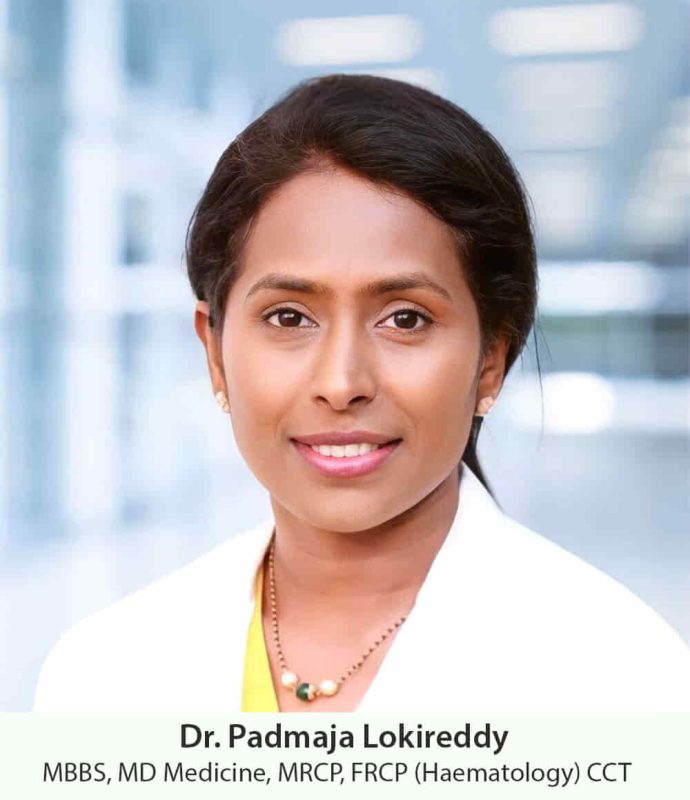
Dr. Padmaja Lokireddy is a highly respected Hemato Oncologist, Bone Marrow & Stem Cell Transplant Surgeon with years of experience in the field. She earned her postgraduate degree in internal medicine from the prestigious Manipal Academy of Higher Education and continued her studies and worked in the UK for about 13 years.

0
Years of experience
let counter = document.getElementById(‘experience-counter’);
let count = 0;
let target = 13;
let interval = setInterval(() => {
if (count < target) {
count++;
counter.innerText = count;
} else {
clearInterval(interval);
counter.innerText = target + “+”;
}
}, 300);

0
Patients Treated
let patientsCounter = document.getElementById(‘patients-counter’);
let patientsCount = 0;
let patientsTarget = 5000;
let patientsStep = 50;
let patientsInterval = setInterval(() => {
if (patientsCount patientsTarget) patientsCount = patientsTarget;
patientsCounter.innerText = patientsCount;
} else {
clearInterval(patientsInterval);
patientsCounter.innerText = patientsTarget + “+”;
}
}, 10);

0%
Success rate
let successCounter = document.getElementById(‘success-counter’);
let successCount = 0;
let successTarget = 99;
let successInterval = setInterval(() => {
if (successCount < successTarget) {
successCount++;
successCounter.innerText = successCount + “%”;
} else {
clearInterval(successInterval);
successCounter.innerText = successTarget + “%”;
}
}, 30);
AWARDS
India Brand Icon Award – 2020
India Brand Icon Award for Healthcare Excellence (Hemato-Oncology & Bone Marrow Transplant) By Time Cyber Media.
Meritorious Award
Meritorious Award in the field of Hematology and Transplant by International Biographic centre, Cambridge 2016.
International Biographic Dictionary, Cambridge
Included in International Biographic Dictionary, Cambridge and recognised in the top 100 physicians for 2016.
India Brand Icon Award – 2020
India Brand Icon Award for Healthcare Excellence (Hemato-Oncology & Bone Marrow Transplant) By Time Cyber Media.
Meritorious Award
Meritorious Award in the field of Hematology and Transplant by International Biographic centre, Cambridge 2016.
International Biographic Dictionary, Cambridge
Included in International Biographic Dictionary, Cambridge and recognised in the top 100 physicians for 2016.