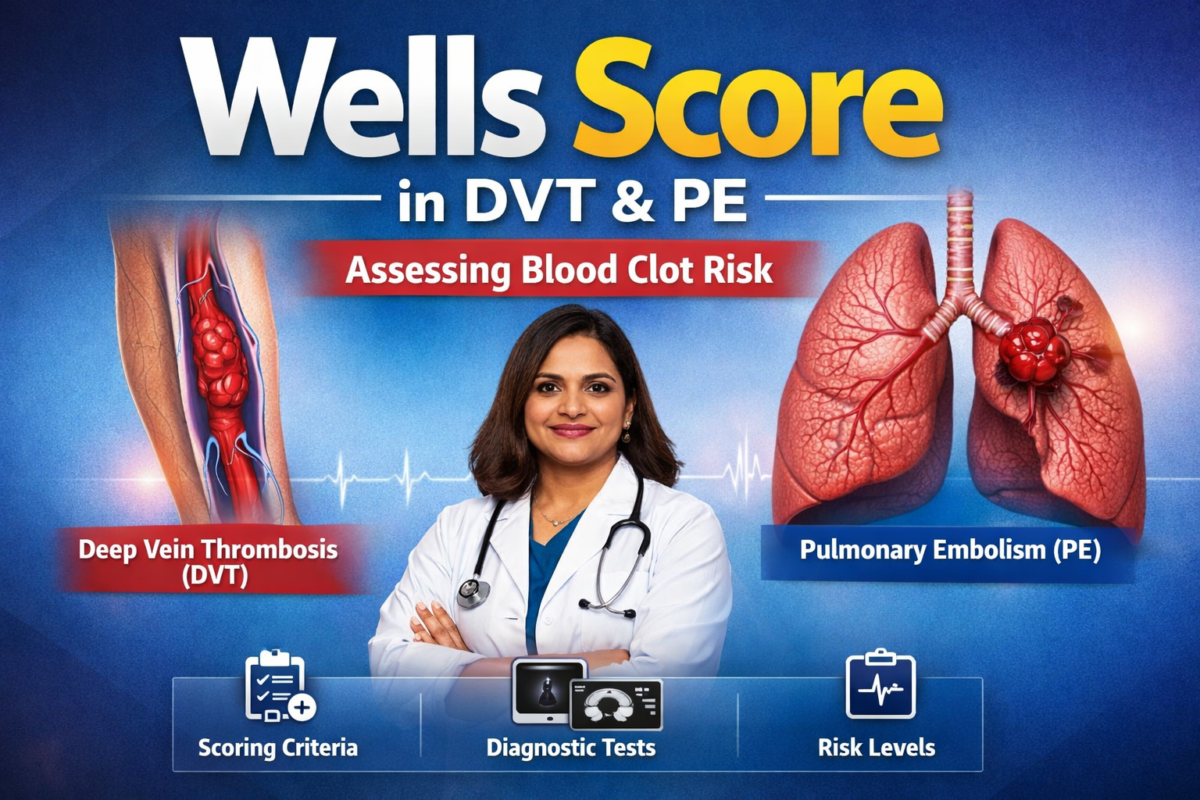
Blood clots could be life-threatening in the event that they are not treated promptly. The conditions like Deep Vein Thrombosis (DVT) and Pulmonary Embolism (PE) often exhibit symptoms that appear to be mild and could be misinterpreted as more benign issues.
This is that’s where Wells Score is a straightforward, reliable diagnostic tool that can help you assess your risk of developing blood clots, and help you determine the cause.
If you’re wondering how medical professionals determine if an ankle swelling could be an actual clot, or if chest pain could be dangerous this guide will give you the information needed.
How do I calculate it? Wells score?
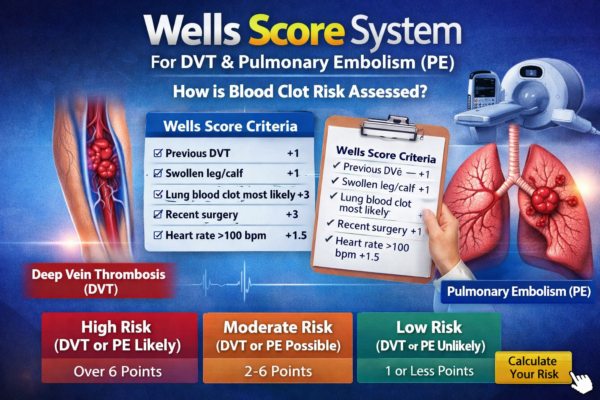
The Wells Score is a clinical predictor developed by Dr. Philip Wells to estimate the probability of suffering from DVT or PE.
It utilizes specific criteria for clinical diagnosis and assigns points according to the symptoms and the history.
A higher score indicates an increased chance of developing an ailment, which can prompt doctors to continue through the imaging test or laboratory work.
There are two interpretations that are based on Wells Score.
- Wells Score of DVT – determines the DVT risk
- Wells Score of PE A tool that doctors use to assess the likelihood for someone to have an embolism in their lungs.
What’s the point?
The appearance of blood clots is deceiving and even deadly. A blood clot that forms in the leg (DVT) could spread to your lungs, causing an embolism in your pulmonary veins that can be life-threatening if you don’t get treatment. It is the Wells Score helps doctors categorize patients more quickly and prioritize urgent treatment.
By predicting the likelihood of the clot, it helps avoid unnecessary tests for low-risk patients and speedily diagnoses high-risk ones, thereby saving time and lives.
What does the Wells Score calculated?
The Wells Score isn’t a blood or imaging test. It’s a decision-making tool used in clinical settings. Your doctor will inquire about your symptoms, as well as recent medical background (like immobility, surgery, or cancer) and look for any indications like leg swelling, tenderness or an irregular heart rate.
Each element is assigned a value and the score can be used to determine how likely it is that you’ve got PE or DVT. Based on the results the doctor can order additional tests such as a D-dimer Blood test or ultrasound or CT angiogram of the pulmonary system.
Wells score for DVT
Criteria for Scoring and Evaluation
The Wells Score for DVT gives points to the presence of clinical signs or risk elements. This is how it is done:
| Criteria | Points |
| Cancer that is active (within six months) | +1 |
| Partial loss of movement, recent casting of lower legs | +1 |
| Acutely ill for more than three days or had an operation that is major within the last 12 weeks. | +1 |
| Localized tenderness in deep vein system | +1 |
| Entire leg swollen | +1 |
| Calf swelling >3 cm in comparison to an asymptomatic leg | +1 |
| Pitting edema that is confined to asymptomatic leg | +1 |
| Collateral superficial veins (non-varicose) | +1 |
| The DVT was previously documented. | +1 |
| A second diagnosis is at the very least similar to DVT | -2 |
Interpretation:
- >3 points = High chance of DVT
- 1 point = Moderate Probability
- 1 (or less) = Low Probability
Wells Score of Pulmonary Embolism
Scoring Criteria, and Scoring
The PE version employs an entirely different set of indicators:
| Criteria | Points |
| The clinical signs of DVT | +3 |
| Most likely is the PE diagnosis. | +3 |
| Heart rate >100 beats per minute | +1.5 |
| In the over the last 4 weeks | +1.5 |
| Previous PE or DVT | +1.5 |
| Hemoptysis (coughing up blood) | +1 |
| Active cancer | +1 |
Interpretation (Original):
- more than 6 points = High chance
- 2-6 Points = Moderate Probability
- 2 points = Low chance
modified Wells Score for PE
- 4 points or more = PE most likely
- 4 points = PE likely
A simplified model (the altered Wells Score) is often used in emergency situations to speed up the process of making decisions.
Changed Wells Score: What’s different?
Modified version an streamlined version of the original Wells Score, especially useful for cases of pulmonary embolism. Instead of three levels (low moderate, medium, and high) the modified version employs a binary method “PE probably” and “PE not likely.”
If a patient’s score is less than 4 (PE unlikely) Doctors typically suggest taking a D-dimer blood test to begin. If the test results are positive the next step is to perform a CT scan to determine if there are blood clots in the lungs. If PE is suspected, imaging can be done immediately without waiting.
This minimizes radiation exposure and prioritizes high risk cases, thereby improving the safety of patients and results.
What is the role of doctors using Wells Score? Wells Score?
Consider this situation: A 60-year-old man comes to the Emergency Room with sudden chest discomfort and breathlessness. He underwent surgery on his hip a couple of weeks ago, and is resting a lot since the surgery. The heart rate of his is elevated and he is feeling faint. The doctor conducts an Wells Score assessment for PE:
- Recent surgery: +1.5
- Heart rate >100 beats per minute: +1.5
- The most probable diagnosis is PE. +3
The Total Score is 6 – – Very High risk of developing a Pulmonary Embolism
The doctor skips the D-dimer, and is referred to an CT pulmonary angiogram, which confirms the diagnosis.
The limitations of the Wells Score
Although extremely helpful but the Wells Score isn’t foolproof:
- It’s based on clinical judgement that can be influenced by a variety of factors.
- Certain symptoms (like leg pain in the legs) are not specific.
- It is recommended to use it in conjunction along with imaging and D-dimer testing to confirm.
Always trust your doctor’s recommendation to perform additional tests, regardless of whether you’re Wells Score isn’t high.
What should you do if you are worried?
Medical attention should be sought immediately if you notice any of the symptoms listed below. These may be symptoms for a blood clot and early detection tools such as Wells Score Wells Score can make a crucial difference.
DVT Symptoms to Lookout for:
- Acute leg swelling (usually one-sided)
- Tenderness or pain in the leg
- Redness and warmth over the region
Pulmonary Embolism The symptoms are:
- Shortness of breath that is sudden
- Pain in the chest (worse when you breathe deeply)
- Heart rate rapid
- A fainting or lightheaded feeling
- Sniffing blood
You or someone else you are aware of shows these symptoms, you should seek urgent treatment immediately.
Need expert advice?
Worried about symptoms of DVT or Pulmonary Embolism? Consult a hematologist near me today. Book your appointment now for expert evaluation and timely treatment.
