

For people undergoing treatment for blood cancer, knowing whether the disease is responding to therapy is an important part of the treatment journey. Traditional tests may show that cancer cells are no longer detectable at a standard level, but very small numbers of abnormal cells can sometimes remain in the body. These cells may be too few to be detected through routine testing.
This is where Minimal Residual Disease (MRD) testing can play an important role. MRD testing uses highly sensitive laboratory techniques to identify tiny amounts of cancer that may remain after treatment. It can provide doctors with additional information about treatment response and help guide further management in certain blood cancers.
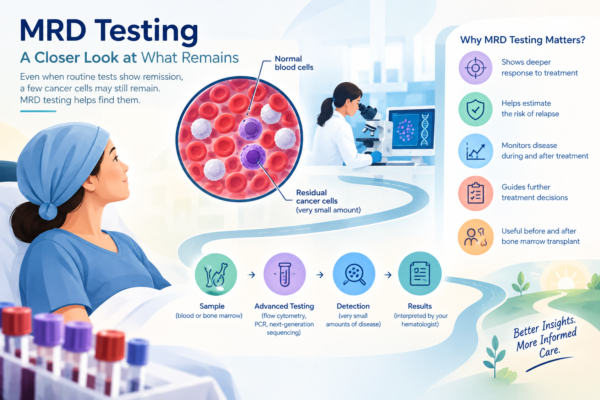
What Is Minimal Residual Disease?
Minimal Residual Disease refers to the small number of abnormal or cancerous cells that may remain in the body after treatment, even when a patient appears to be in remission based on conventional tests.
For example, a patient with leukemia may have a normal-looking blood count and no obvious signs of disease after chemotherapy. However, a very small population of abnormal cells could still be present in the bone marrow.
These remaining cells may not be visible through routine microscopy. More sensitive MRD tests can detect them at much lower levels.
MRD is sometimes also referred to as measurable residual disease, because modern testing can measure very small amounts of disease rather than simply determining whether disease is present or absent.
Why Is MRD Testing Important?
The response to treatment can vary significantly between patients. Two people may both achieve what appears to be complete remission using conventional testing, while one may have a very small amount of detectable residual disease.
MRD testing can provide additional information about this deeper level of response.
Depending on the type of blood cancer and treatment, MRD results may help doctors:
- Assess how well treatment has worked
- Identify residual cancer cells after treatment
- Estimate the risk of disease returning
- Monitor the response during or after treatment
- Help determine whether additional treatment may be appropriate
- Monitor disease following a stem cell or bone marrow transplant
MRD is therefore an important part of modern hematology for selected blood cancers.
Which Blood Cancers Use MRD Testing?
MRD testing is particularly relevant in certain leukemias and other hematological malignancies. It is commonly used in diseases such as acute lymphoblastic leukemia (ALL) and acute myeloid leukemia (AML) when an appropriate MRD method is available.
MRD assessment can also be useful in selected cases of other blood cancers, depending on the characteristics of the disease and the available testing method.
The role of MRD is not identical for every blood cancer. The appropriate test, timing and interpretation depend on the specific diagnosis, treatment plan and individual patient factors.
How Is MRD Testing Performed?
The sample used for MRD testing depends on the type of blood cancer and the testing method being used.
In many leukemias, a bone marrow sample may be required because the bone marrow is where abnormal blood-forming cells are found. In some situations, blood may also be used.
The sample is analysed using highly sensitive laboratory techniques designed to identify abnormal cells or specific molecular or genetic markers associated with the cancer.
The most commonly used approaches include:
Flow Cytometry
Flow cytometry identifies abnormal cells based on specific proteins or markers present on their surface or inside the cells.
It can examine a large number of cells and identify populations that have characteristics associated with the patient’s blood cancer.
Molecular Testing
Molecular MRD testing looks for specific genetic or molecular abnormalities associated with the cancer.
Techniques such as polymerase chain reaction (PCR) and other highly sensitive molecular methods may be used when a suitable molecular marker is available.
Next-Generation Sequencing
Next-generation sequencing (NGS) can identify and track specific genetic changes associated with cancer cells. It can provide highly sensitive disease monitoring in selected blood cancers.
The choice of MRD technique depends on the patient’s disease, the markers available and the laboratory methodology.
What Do MRD Results Mean?
MRD results need to be interpreted in the context of the patient’s specific blood cancer and treatment.
A result may indicate that MRD is not detected, meaning the test did not identify measurable disease within the sensitivity and limitations of that particular test.
This does not necessarily mean that every cancer cell has been eliminated. Instead, it means that disease was not detected at or above the test’s detection threshold.
A detectable MRD result means that abnormal cells or disease-associated markers were identified. The significance of this finding depends on the type of cancer, the amount of disease detected, when the sample was collected and the treatment stage.
Therefore, MRD results should always be interpreted by the treating hematologist rather than considered in isolation.
MRD Before and After Bone Marrow Transplant
MRD can be particularly important when evaluating patients who are being considered for or have undergone a bone marrow or stem cell transplant.
Before transplantation, MRD status may provide information about the amount of disease remaining after initial treatment.
Following transplant, MRD testing can help monitor whether the disease remains undetectable or becomes measurable again.
When MRD becomes detectable after a period in which it was not detected, doctors may investigate the result carefully and consider whether additional monitoring or treatment is necessary.
MRD is only one component of post-transplant monitoring. Other factors, including blood counts, bone marrow findings, donor chimerism, clinical condition and other laboratory tests, may also be considered.
How Sensitive Is MRD Testing?
One of the major advantages of MRD testing is its ability to detect disease at levels far below those typically identified through routine examination.
However, the sensitivity varies according to the testing method, laboratory quality, sample quality and the biological characteristics of the cancer.
A negative MRD result therefore does not mean that the patient has absolutely zero cancer cells. It means that the disease was not detected within the sensitivity of the test.
This distinction is important when discussing MRD results with patients and families.
Does MRD Always Predict Relapse?
MRD can provide valuable information about the risk of relapse in several blood cancers, but it should not be viewed as a standalone prediction.
The meaning of an MRD result depends on several factors, including the disease type, treatment received, timing of testing and the patient’s overall clinical situation.
Doctors may compare MRD results over time rather than relying on a single test. Changes in MRD levels can sometimes provide important information about how the disease is responding.
Why Timing Matters in MRD Testing
MRD testing is often performed at specific stages of treatment because the timing can affect how the result is interpreted.
For example, testing after initial treatment may help determine the depth of remission. Additional testing later may help monitor whether the disease remains undetectable.
The treating hematologist determines when MRD testing should be performed based on the patient’s diagnosis and treatment protocol.
Understanding MRD as Part of Personalized Cancer Care
Modern blood cancer treatment increasingly focuses on understanding how an individual patient’s disease responds to therapy.
MRD testing is one tool that can help doctors look beyond conventional measures of remission. By identifying very small amounts of remaining disease, it may provide useful information for treatment planning and ongoing monitoring.
However, MRD testing is not suitable or necessary in exactly the same way for every patient. The test selected, sample required and frequency of monitoring depend on the specific blood cancer and the treatment strategy.
Conclusion
Minimal Residual Disease (MRD) testing is an important tool used in several blood cancers to understand how well the disease has responded to treatment. Even when routine tests show remission, a very small number of cancer cells may remain in the body. MRD testing can help detect these cells and provide additional information about the depth of treatment response.
MRD testing can be especially useful during and after treatments such as chemotherapy and stem cell transplantation. However, MRD results should always be evaluated along with the type of blood cancer, treatment history, bone marrow findings, blood counts and other clinical factors.
If you are looking for expert guidance regarding blood cancers, leukemia, lymphoma, bone marrow disorders or stem cell transplantation, consulting the best hematologist in India can help you understand your condition and available treatment options. If you have been advised to undergo MRD testing or need guidance about your treatment, you can book an appointment with an experienced hematology specialist for personalised medical care.
